
One reason that clinical judgement regularly beats decision rules is that decision rules (at least as they are currently designed) are forced to use arbitrary cut-offs. Imagine you develop a little bit of pleuritic chest pain during your 50th birthday dinner. Head straight to the hospital while you are still 49 and you are PERC negative. Wait until the next morning because you are having a good time, all of a sudden you are PERC positive. Obviously your risk of PE did not change in 12 hours, but because of the arbitrary cutoff, your workup might look dramatically different. Similarly, your risk of a significant head injury doesn’t change just because you turned 65. Hard cut-offs are present in many current decision rules, but they obviously don’t match any underlying biology.
Oishi and colleagues (2026) decided to look at one of these hard cut-offs in the PECARN head injury tool: the height of the fall. Does the transition from 3 feet to 3 feet 1 inch somehow dramatically increase your risk?
Before discussing the details of this paper, it is important to emphasize: based on the best available evidence, you should not be using the PECARN head injury tool. Although it has excellent sensitivity, the specificity is mediocre, and this tool has never been tested in a properly controlled implementation study. It doesn’t have the level of evidence required to support its use in clinical practice. It has been tested against clinical gestalt, and it is very clear that PECARN is worse than clinical judgement. (Babl 2018) With identical sensitivities, but significantly lower specificities, PECARN results in worse decision making than clinical judgement alone. If you use PECARN in your practice, it is almost certainly making you a worse doctor.
It might seem silly to talk about the details of PECARN when you shouldn’t be using PECARN, but I think there are some broader lessons that make a quick review of this paper worthwhile.
The paper
Oishi T, Amagasa S, Uematsu S, Moriya T. Fall height and impact surface in relation to clinically important traumatic brain injury among children under two years. Am J Emerg Med. 2026 Jun;104:79-84. doi: 10.1016/j.ajem.2026.03.002. Epub 2026 Mar 5. PMID: 41819051
The methods
This is a retrospective observational study from a single tertiary care hospital in Japan looking at children younger than 2 presenting to the hospital with head injuries. In addition to the fall height, they also collected data on the impact surface, comparing flooring (wood, laminate, vinyl), to soft surfaces (carpet, cushion, dirt), to hard surfaces (concrete, tile, stone, marble, brick, gravel, asphalt).
The results
A total of 3067 children under 2 years of age presented with a head injury during the 4 year study period, and after various exclusions they are left with a study population of 1893. Fall height was missing in 13% of charts and impact surface was missing in 20%. (Given that the landing surface is not included in any head injury algorithm, I can’t imagine that it was well documented in this retrospective look at the data. I certainly don’t write it in my charts.)
An incredibly high 11% of children underwent head CT. I think this must represent either referral bias, given that this is a single tertiary pediatric hospital, or a problem with their retrospective data collection, because an incredibly high number of these children also had positive CTs. (In my experience, a lot of head injuries are triaged as lacerations and so could be left out of this retrospective data.) 85 children (3% overall or 40% of the kids scanned) had abnormal CTs, and 44 (1% overall or 20% of those scanned) were diagnosed with clinically important traumatic brain injuries.
Based on their statistics, they claim that impact surface is not correlated with abnormal CT findings, but their study is clearly underpowered. As compared to flooring, soft surfaces had a significantly lower risk (odds ratio 0.3), but it just wasn’t statistically significant (95% CI 0.07-1.34). Hard surfaces look slightly worse (OR 1.1 95% CI 0.5-2.3).
There was a statistical correlation between fall height and the risk of clinically important TBI, with every 10 cm increase in height representing an odds ratio of 1.31 (95% CI 1.19-1.45).
My thoughts
The value of this study is somewhat limited because, based on the best available evidence in 2026, no one should be using the PECARN head injury tool. There are no properly controlled implementation studies. (A few before and after studies with stupidly high CT rates in the before period don’t really tell you much). The tool performs worse than clinical judgement. (Babl 2018) If you are currently using the decision tool, it is probably making you worse at your job.
Head injury is easy. You are trying to determine whether a child requires brain surgery. If a child is awake and acting normally, they probably don’t need brain surgery. If you were to offer brain surgery to that child’s parents, they would probably want another doctor. That is how I frame my discussions around CTs. If your child doesn’t need brain surgery, there is nothing important that we will find on a CT, so why expose your child to radiation (and multiple extra hours in an emergency department)? When framed like that, I have never had a parent ask for a CT.
This cohort has an astronomically high rate of CT usage. It is multiple orders of magnitude higher than my personal CT rate, and at least 10x higher than even the most CT happy physicians I have worked with in Canada. Head injury is one of the most common pediatric presentations, and I work in busy community hospitals. I see multiple children every shift with head injuries, and during my 15 year career I have scanned fewer than 10 children. There are many possible explanations for a high rate of CT. It can be cultural. It could be caused by using a low specificity decision tool. However, in this study I think it is either the result of biased data collection or referral bias at a trauma center, because there was a very high rate of pathology. In other words, unless you are working in a pediatric trauma centre, this data almost certainly doesn’t apply to your practice.
I think this study is a great example of how some doctors allow their clinical judgement to be warped by decision rules. I know many doctors who use 3 feet as a strict cut-off, just like many doctors use age 65 as a cut-off because of the Canadian CT head rule. (Another rule that absolutely should not be used in clinical practice.) Strict arbitrary cut-offs are silly.
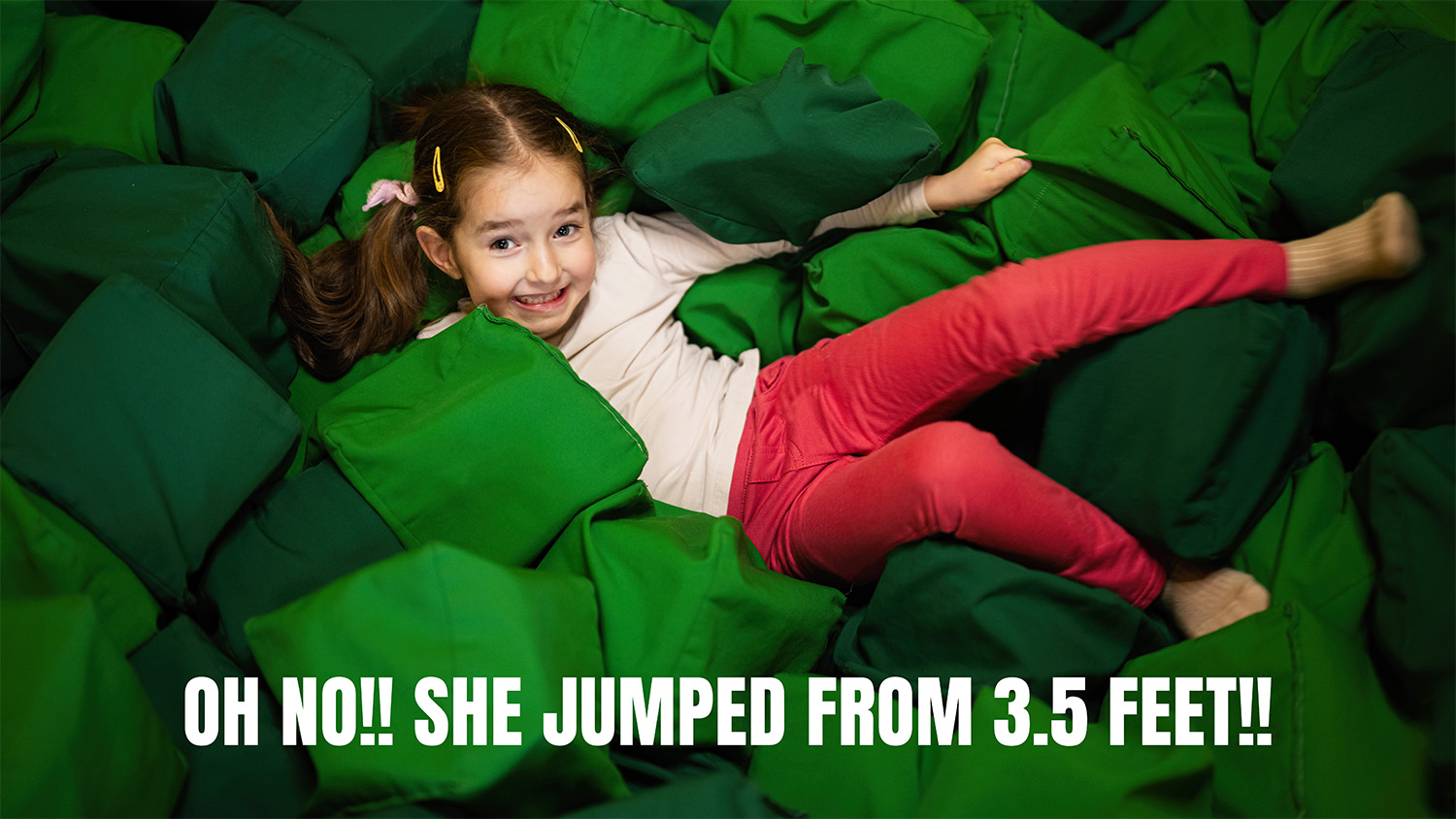
We have a bouncy castle at our house. Many children have been thrown far higher than 3 feet in the air, immediately bouncing back up and asking for more. I have seen children dive head first into pillow forts. I claim no personal responsibility for these actions, but not all falls are created equal. Clinical judgement is important. Impact surface matters. Height matters. More important than either is the appearance of the child in front of you. There is no simple black and white rule you can rely on. You are a doctor. You are smart. You are paid well. Stop trying to let an algorithm make decisions for you.
I have always thought that discussions of ‘mechanism of injury’ as a risk factor are sort of stupid for emergency physicians. Mechanism of injury may play an important role in EMS triage and transport decisions immediately after trauma, but by the time the patient arrives at the hospital, you can evaluate them clinically.
We have all seen pedestrians struck by motor vehicles who are walking around the department with no complaints at all. At that point, your normal vitals, normal physical exam, and lack of symptoms is far more important than the mechanism of injury. Conversely, it would be insane to discount a patient’s pain and inability to walk just because the mechanism of injury seems minor. History and physical are orders of magnitude more important than the mechanism of injury. Decision rules that incorporate mechanism of injury are always going to be overly sensitive, and poorly specific, resulting in over-testing.
An arbitrary cutoff of 3 ft is ridiculous. The risk slowly increases the higher you get. The same goes for age. I don’t CT most 68 year olds who hit their head, but my rate is higher if you are 95. I see a huge number of kids who fall from over 3 feet, and send the vast majority home immediately. However, a fall from 10 feet gets my attention.
Forget about the PECARN rule. Don’t use the PECARN rule. Use this paper to allow yourself to think about the many arbitrary cut-offs you use in your practice.
Our jobs can certainly be hard, but sometimes it seems like we are trying to make them harder. It is really not difficult to identify children (or adults) who need neurosurgical interventions. You can usually do it from the doorway. The parents can do it. The janitor can do it. Why make your life more difficult with poorly designed tools, which contain biologically nonsensical arbitrary cut-offs? Take some pride in your intelligence and training, and just make a decision.
References
Babl FE, Oakley E, Dalziel SR, et al. Accuracy of Clinician Practice Compared With Three Head Injury Decision Rules in Children: A Prospective Cohort Study. Annals of emergency medicine. 2018; 71(6):703-710. PMID: 29452747
Oishi T, Amagasa S, Uematsu S, Moriya T. Fall height and impact surface in relation to clinically important traumatic brain injury among children under two years. Am J Emerg Med. 2026 Jun;104:79-84. doi: 10.1016/j.ajem.2026.03.002. Epub 2026 Mar 5. PMID: 41819051


2 thoughts on “3 foot falls and other arbitrary cutoffs we use (Oishi 2026)”
Sensible, brave, unlikely to be followed by many looking for quick and easy answers.
I agree re: the CT rate (and positive CT rate) seems very high – but then nearly 50% of the positive CT findings are for isolated skull fracture without TBI. It begs the questions as to how important it is/isn’t (likely medicolegally) to confirm a skull fracture with CT in a well-appearing child who will not require neurosurgical intervention. Will a parent accept “probably/clinically a skull fracture” without a scan? I wish there were an easier way of simply confirming a skull fracture without a CT – but PREDICT (in Australia) risk stratifies “palpable skull fracture” into high-risk (therefore recommending imaging) irrespective of how well-appearing a child might be.