Morgenstern, J. Will whole blood data end up wholey negative?, First10EM, June 15, 2026. Available at:
https://doi.org/10.51684/FIRS.146106
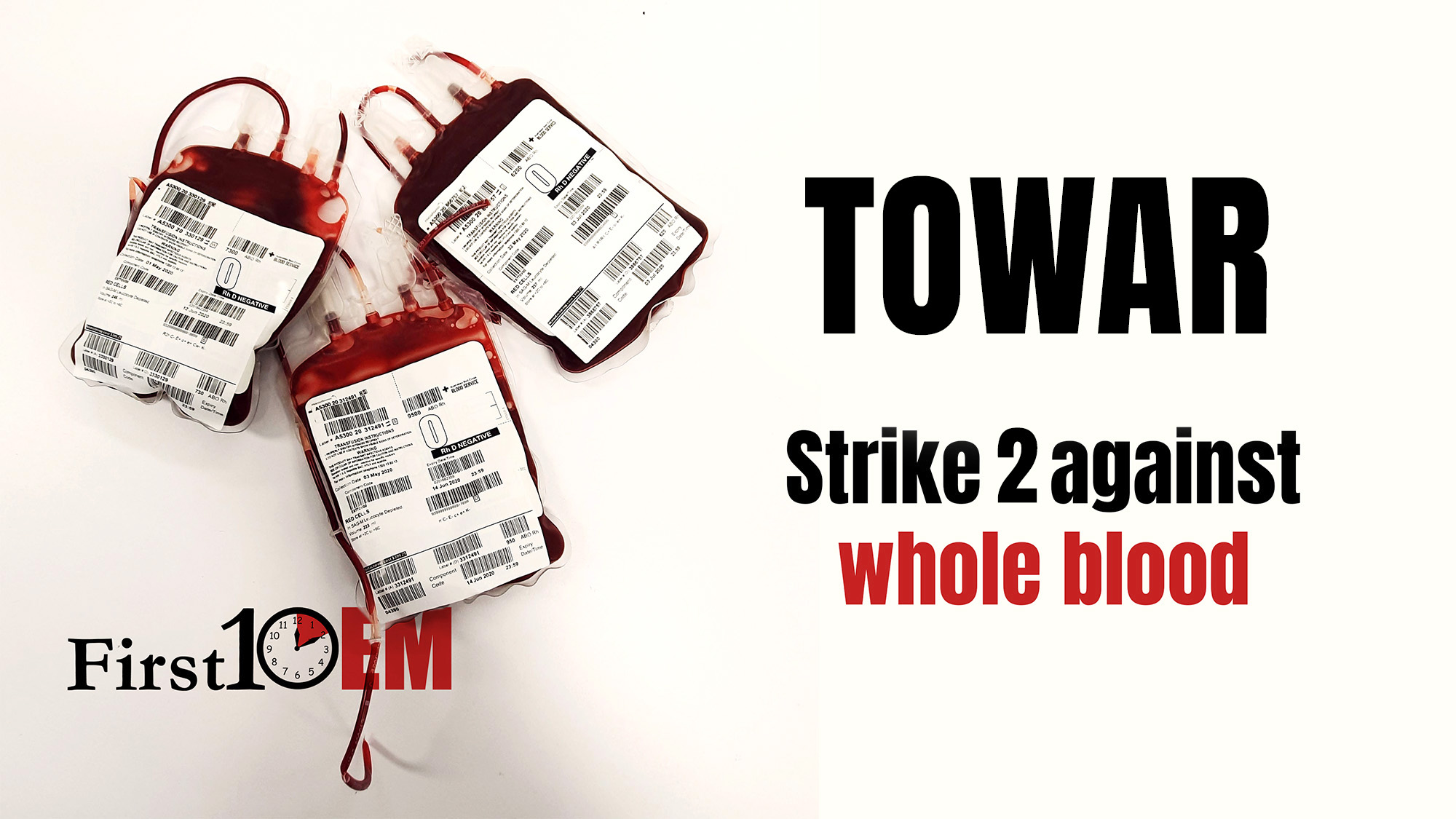
Despite some theoretical arguments in its favour, my deep dive into massive transfusion left me very skeptical of the concept of whole blood. I recently covered the SwiFT trial, which showed no benefit of 2 units of whole blood in the preshospital setting. What are the chances that the TOWAR trial will provide us with more promising results?
The question
In prehospital trauma patients with hemorrhagic shock, does low-titer group O whole blood improve 30 day mortality as compared with blood components?
The paper
Sperry JL, Guyette FX, Cotton BA, Luther JF, Utarnachitt RB, Kutcher ME, Daley BJ, Peetz AB, Patel MB, Goodman MD, Claridge JA, Patel N, Harbrecht BG, Hashmi ZG, Zarychanski R, Neal MD, Yazer MH, Martin-Gill C, Vincent LE, Harner AM, Meyer DE, Latimer AJ, Robinson BR, McKnight CL, Hinckley WR, Miller KR, Jansen JO, Martin D, Fox EE, Rosario-Rivera BL, Wisniewski SR; TOWAR Study Group. Prehospital Resuscitation with Type O Whole Blood for Trauma and Hemorrhage. N Engl J Med. 2026 May 18. doi: 10.1056/NEJMoa2602167. PMID: 42150044 NCT04684719
The methods
The TOWAR study is a pragmatic, multicenter, phase 3, cluster randomized clinical trial.
Patients
Patients transferred from the scene of injury or a referring emergency department to a participating trauma center who had at least one episode of hypotension (systolic less than 91) accompanied by tachycardia (heart rate over 107), or any systolic blood pressure less than 71.
Exclusions: Age less than 18 or more than 90, isolated fall from standing, hanging, drowning, traumatic cardiac arrest, penetrating brain injury, inability to establish vascular access.
Randomization occurred at the level of the air medical base, with a 2:1 ratio of whole blood to component therapy.
Intervention
“Air medical bases assigned to use whole blood for a given month were stocked with 2 units of group O blood with anti-A and anti-B titers of less than 256 and a shelf life of up to 21 days. Eligible patients received up to 2 units of whole blood, with administration of the second unit guided by clinical status and site protocols.”
Comparison
“Bases assigned to the component group were stocked with red cells, plasma, or both; eligible patients received component therapy according to standard transfusion practices without protocol-defined minimums or limits.”
Outcome
The primary outcome was all cause mortality within 30 days.
The results
They include 1020 patients (out of 1098 eligible), with 715 assigned to whole blood and 305 assigned to component therapy. The group was relatively sick, with a median ISS of 25, and 62% receiving operative therapy within 24 hours. The groups look pretty similar at baseline, but the whole blood group might be a little sicker (higher ISS, lower GCS, higher rate of brain injury).
Procol adherence was OK (but the EMS bases were allowed to carry and give non-study blood products). In the whole blood group, 343 patients (48.0%) received 1 unit of whole blood, 326 (45.6%) received 2 units of whole blood, and 46 (6.4%) received no whole blood, but 226 (31.6%) received blood components, either alone or in addition to whole blood. In the component group, 136 patients (44.6%) received 1 unit of red cells, 129 (42.3%) received 2 units of red cells, 117 (38.4%) received 1 unit of plasma, and 93 (30.5%) received 2 units of plasma; 175 patients (57.4%) received both red cells and plasma, but 15 (4.9%) received 1 unit of whole blood and 11 (3.6%) received 2 units of whole blood.
There was no difference in the primary outcome of 30 day mortality, but the point estimate for whole blood looks a lot worse (25.9% vs 20.5%, aOR 1.24, 95% CI 0.87-1.76, p=0.24).

They included an embedded observational study to look at the effect of whole blood storage age, and there did not seem to be any difference between blood with a storage age 1-14 days as compared to older blood stored between 15-21 days.
My thoughts
The 5% increase in mortality was not statistically significant, but these results are important, and should receive attention. A 5% increase in mortality would clearly be clinically significant. Although well within the realm of statistical chance, these results should dramatically temper enthusiasm for whole blood. (If you had any. As I have said before, I think there is very little reason to think that whole blood will be helpful, and reason to believe it could be harmful). This 5% increase in mortality makes it very clear that whole blood is not a strategy that should be used clinically outside of clinical trials in 2026.
I have said it many times before, and I am probably destined to say it many times in the future: modern sample size calculations are a complete farce, and probably should just be dropped altogether. They powered this trial on the assumption that whole blood would result in a 10% reduction in mortality. No one believes whole blood will result in a 10% reduction in mortality, as compared to component therapy. Aspirin only reduces mortality by 2.5% in STEMI. These authors were claiming that whole blood, as a replacement for component blood, was going to be 4 times as effective as ASA in STEMI, and no one called them on it. As a result, the trial is incredibly underpowered from the outset. (Don’t accuse me of not understanding the pragmatic reasons behind these power calculations. I know big trials are hard. But instead of pretending your trial was sized based on a scientific calculation, just be honest and say, “we can only afford to enroll 1000 patients in our trials, so we are willing to accept whatever power that provides.”) The lack of power is incredibly evident in the fact that they found an incredibly important 5% increase in mortality, and they are nowhere close to having enough power to determine if that is a true effect. I would be very cautious in extrapolating point estimates from statistically negative trials, but when you are talking about a point estimate that suggests dramatic harm from an unproven experimental therapy, I think you need to pause and reflect.
Of course, as I mentioned above, the whole blood group looked somewhat sicker at baseline, and this is a cluster RCT rather than a true RCT, so it would be a mistake to read too much into this large increase in mortality with whole blood.
There was a fairly high degree of cross-over between the two groups. (30% of the whole blood group received components, and 10% of the component groups received whole blood). And that doesn’t even account for the fact that in-hospital blood products were not part of this trial. Much like the SWiFT trial, I don’t think 2 units of blood are going to make any difference at all. Both of these effects should bias the trial towards the null hypothesis, which again makes me more nervous about the 5% increase in mortality.
I don’t know why whole blood is being tested in the prehospital setting, where blood products are much harder to stock and control, before it has ever been shown to be of benefit to patients. We don’t know if whole blood has any effect, but even if it does, it is extremely unlikely that the effect will be seen from just the first 2 units. The only place that I could see whole blood differing from component therapy is in the setting of massive transfusion. Personally, I would like to see this studied in trauma centers before we see any more prehospital trials.
Bottom line
This is a statistically negative trial, but the 5% increase in mortality seen with whole blood is a red flag. Although we definitely need more research in this area, it is very clear that no one should be using whole blood clinically at this time.
Did you find this information useful? There are many other First10EM critical appraisals, which can be found here. Also, consider subscribing to this blog:
If you really find First10EM helpful to your practice, consider supporting us financially:

Other FOAMed
No benefit from whole blood – the SWiFT trial
Massive hemorrhage: a very deep dive
Evidence based medicine is easy
Evidence based medicine resources
References
Sperry JL, Guyette FX, Cotton BA, Luther JF, Utarnachitt RB, Kutcher ME, Daley BJ, Peetz AB, Patel MB, Goodman MD, Claridge JA, Patel N, Harbrecht BG, Hashmi ZG, Zarychanski R, Neal MD, Yazer MH, Martin-Gill C, Vincent LE, Harner AM, Meyer DE, Latimer AJ, Robinson BR, McKnight CL, Hinckley WR, Miller KR, Jansen JO, Martin D, Fox EE, Rosario-Rivera BL, Wisniewski SR; TOWAR Study Group. Prehospital Resuscitation with Type O Whole Blood for Trauma and Hemorrhage. N Engl J Med. 2026 May 18. doi: 10.1056/NEJMoa2602167. PMID: 42150044
The SWiFT trial: Smith JE, Cardigan R, Sanderson E, Silsby L, Rourke C, Barnard EBG, Basham P, Antonacci G, Charlewood R, Dallas N, Davies J, Goodwin E, Hawton A, Hudson C, Lucas J, Keen K, Lyon RM, Nolan B, Perkins GD, Rundell V, Smith L, Stanworth SJ, Weaver A, Woolley T, Green L; SWiFT Trial Group. Prehospital Whole Blood in Traumatic Hemorrhage – a Randomized Controlled Trial. N Engl J Med. 2026 Mar 17. doi: 10.1056/NEJMoa2516043. Epub ahead of print. PMID: 41841706