
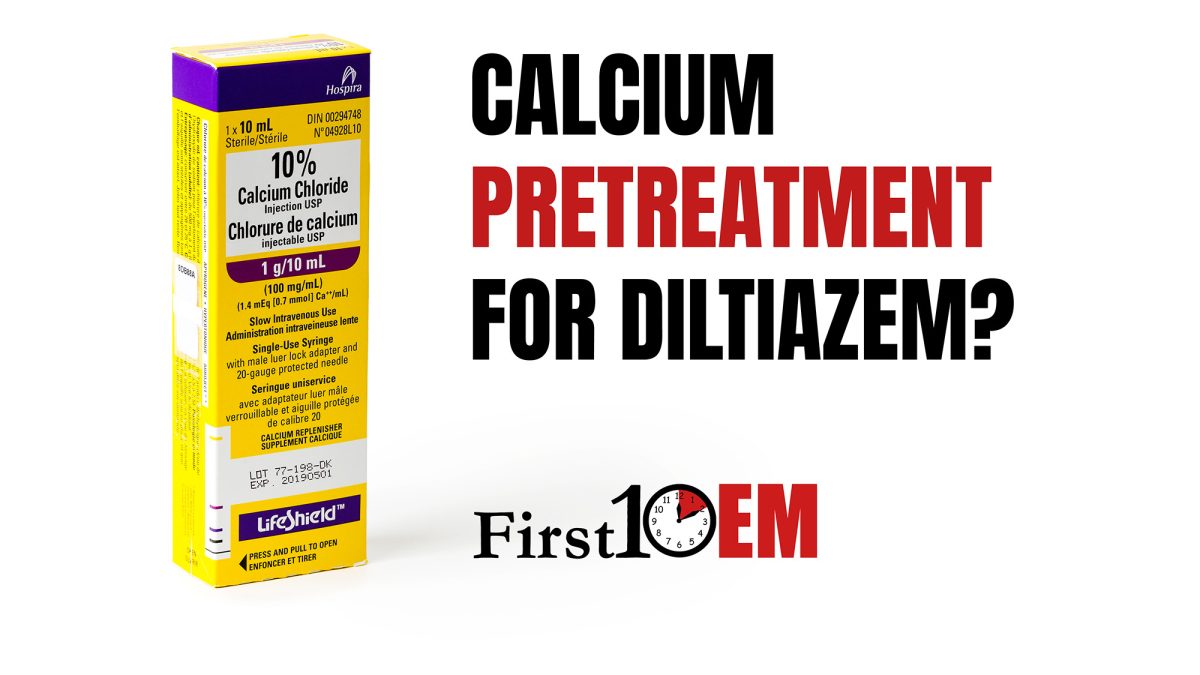
Morgenstern, J. Diltiazem for atrial fibrillation: does calcium pretreatment help?, First10EM, February 24, 2025. Available at:
https://doi.org/10.51684/FIRS.140962
I have covered calcium channel blockers for atrial fibrillation a number of times. If you are pursuing a rate control approach, calcium channel blockers probably result in more rapid control. Thus, if you are trying to send these patients home, they might be a good choice. However, for long term management, cardiologists seem to prefer beta-blockers (which will often make sense given co-morbidities). With either choice, a small percentage of patients will develop complications, primarily hypotension. Although most hypotensive events are short lived, minor, and can probably be ignored, there is a question of whether they can be avoided in calcium channel blockers by pretreatment with calcium. This RCT asks that question.
The paper
Az A, Sogut O, Dogan Y, Akdemir T, Ergenc H, Umit TB, Celik AF, Armagan BN, Bilici E, Cakmak S. Reducing diltiazem-related hypotension in atrial fibrillation: Role of pretreatment intravenous calcium. Am J Emerg Med. 2025 Feb;88:23-28. doi: 10.1016/j.ajem.2024.11.033. Epub 2024 Nov 17. PMID: 39577214 NCT06494007
The Methods
This is a single center double-blind placebo controlled RCT.
Patients
Adult patients with atrial fibrillation and a heart rate over 120.
Exclusions: pregnancy, hemodynamic instability requiring cardioversion, documented history of sick sinus syndrome, WPW, 3rd degree AV block, hypercalcemia, allergy to calcium channel blocker, or current use of an oral rate control agent.
Intervention 1
90 mg IV calcium chloride.
Intervention 2
180 mg IV calcium chloride.
(The dosing here is a little confusing, because it is done in elemental calcium. One amp of calcium chloride is a 1 gram dose, but that only contains 273 mg of elemental calcium. Thus, we are talking about roughly ⅓ or ⅔ of an amp of calcium chloride, which would be equivalent to 1 or 2 grams of calcium gluconate. 1 amp of calcium gluconate contains about 90 mg of elemental calcium.)
Comparison
Saline placebo.
Shared procedures
All patients received a 0.25mg/kg IV bolus of diltiazem over 2 min.
Outcome
The primary outcome was the change in systolic blood pressure at 5, 10, and 15 minutes.
The Results
They enrolled 421 patients, but only 217 are included in the study. Unfortunately, the vast majority of these exclusions are just patients who refused to participate, which is a very high number, and could bias the results. Patients were a mean age of about 64, with about a 50/50 male/female mix. The baseline heart rate was about 158 and the initial systolic blood pressure was about 132.
All three groups had significant changes in heart rate by 5 minutes. There were statistically (but questionably clinically) significant differences in the blood pressure compared to baseline in the placebo group and the 90 mg calcium group, but not the 180 mg calcium group. As far as I can tell, statistics are not used to compare the groups to each other. At the 15 minute mark, the systolic blood pressure had decreased by 15 mmHg with placebo, 9 with 90 mg calcium, and 1 with 180 mg calcium.
There was no statistical difference in the rate of adverse events between the 3 groups. Hypotension, which doesn’t seem to be defined in the paper, occurred in 7% of the placebo group, 6% of the 90 mg group, and 1% of the 180 mg group.


My thoughts
This is a good study. It is an excellent question to address with a double-blind, placebo controlled trial, and I am very impressed that they were able to enroll so many patients from a single hospital in just 18 months. The only major issue with this paper is that their conclusions are clearly way too strong.
There is a statistically significant difference here, but I sincerely doubt that there was a clinically important difference. The mean systolic blood pressure stayed above 115 at all times in all groups. There was no statistical difference in hypotension or adverse events. There might be a real difference there, but without a definition of hypotension, it is hard to know whether any of these events were important.
Rather than pretreating with calcium, it is highly likely that almost all of these hypotensive events could have been avoided by just adjusting the administration of diltiazem. Although they describe their bolus as “slow”, this is a much bigger and faster dose than most people are using. If I am given the 0.25 mg/kg diltiazem dose, I usually do it over 10-15 minutes. If for some reason I think a bolus is necessary, I start with a smaller dose. I essentially never see hypotension in my practice, and when it occurs, it is almost never clinically significant.
It is unclear to me why they opted to use calcium chloride over calcium gluconate. Calcium chloride is usually reserved for patients with central access, as it can cause significant tissue damage if extravasated. They don’t specifically comment on extravasation in this paper. It is a rare side effect, but so is important hypotension from diltiazem. For this paper to truly be practice changing, it would probably need to be much much larger, in order to be powered to identify both of those rare events.
There are a few other minor issues with this paper. They actually have 3 primary outcomes, which is a faux-pas. It doesn’t appear to have mattered based on the way they present their results, but it adds researcher degrees of freedom and significantly increases the risk of false positives to have multiple primary outcomes.
Statistically, they appear to compare each group to its own baseline, rather than comparing the groups to each other, which I don’t think is the appropriate approach. (Or at least, they probably shouldn’t be making conclusions about the differences between the groups if they didn’t mathematically compare the groups. Happy to hear comments on this, as my training in stats is limited.)
Another problem with this trial is that they stopped looking at these patients at 15 minutes. From my reading, the half life of IV diltiazem is about 3.5 hours. It’s harder to find information on the half life of IV calcium, but I think it is closer to 1.5 hours. Therefore, although this approach might prevent early hypotensive episodes, you could imagine a number of later hypotensive episodes (which might actually be more dangerous because they might be more likely to be missed). That being said, I almost never see clinically significant hypotension with diltiazem, and I use it a lot.
Overall, I think this is a well done trial that demonstrates even with aggressive boluses of diltiazem, hypotension is not a real clinical concern. If there is no clinically significant hypotension, it is hard to justify the need for agents to prevent hypotension. I definitely won’t be doing this routinely. I can imagine using this very selectively in a patient in whom I am really concerned about hypotension, although if I do choose to treat with calcium, I will definitely be using calcium gluconate over calcium chloride.
Bottom line
This is a well done, blinded RCT that demonstrates that prophylaxis with calcium in atrial fibrillation patients being treated with diltiazem might result in statistically higher blood pressures, but doesn’t seem to have much of a clinically important impact.
Other FOAMed
Evidence based medicine is easy
Evidence based medicine resources
References
Az A, Sogut O, Dogan Y, Akdemir T, Ergenc H, Umit TB, Celik AF, Armagan BN, Bilici E, Cakmak S. Reducing diltiazem-related hypotension in atrial fibrillation: Role of pretreatment intravenous calcium. Am J Emerg Med. 2025 Feb;88:23-28. doi: 10.1016/j.ajem.2024.11.033. Epub 2024 Nov 17. PMID: 39577214


10 thoughts on “Diltiazem for atrial fibrillation: does calcium pretreatment help?”
Are you used to diluite diltiazem in NaCl 0.9% 100cc in order to get a “10 min” infusion? It seems quite troublesome. I use to infuse it in about one minute (diluiting in 20cc syringe), even large doses.
I think that clinically relevant hypotension side effect depends much more on “heart contractility” and “AF etiology” than the amount of dose.
Giacomo
I am not sure why the 100 mL bag is more troublesome than the syringe? There is essentially never a rush to treat atrial fibrillation, so why have the doctor stand at the bedside pushing the medication, rather than just letting it drip in slowly? It seems far more troublesome to me to have to stand there doing a slow push, and also riskier to give the medicine faster than necessary. Its possible we are picturing different patients. There is an incredibly rare atrial fibrillation patient who is actually very sick from an incredibly fast heart rate. I am fine with pushing diltiazem in those patients, although cardioversion is probably the better option. However, I am not waiting to pretreat with calcium if the patient is actually sick enough to need a push dose of diltiazem.
I agree that the bigger issue with calcium channel blockers is using them in the wrong patient. However, there is no good mechanism to explain why pretreating with calcium would avoid hypotension in patients with cardiomyopathy, so I am not sure this paper really addresses that concern.
My thoughts. Unfortunately I don’t have access to the full article without paying for it.
– Does the study apply to my population of rapid afib patients?
I don’t think so. Numerous exclusion criteria. Some make sense (like needing to be cardioverted), but the main is that the patient is not already on a nodal blocking agent. Almost all of my patients are. Occasionally I see newly diagnosed afib, but in general it is rare. The best study would be to include patients we see the most often, which are rate controlled chronic afibbers who come in with rapid afib. So overall I would be excluding roughly 80-90% of all my patients who come in with rapid afib, which doesn’t make this study helpful.
– Is the intervention the same thing I would do in my practice?
No it is not. I never give calcium chloride unless a patient has central access or it’s a code for the reasons you stated. I always choose calcium gluconate. Why did this single center trial use this medication? I don’t know where it was conducted, but I suspect from the author list that it was not done in the US. Perhaps that is the standard of care at that institution, but at the ones I’ve worked at here in the states (a total of 6 ER sites) we never give calcium chloride in a peripheral IV.
This is a big issue. I don’t know if one can easily swap out CaCl for CaGlu and just assume you would get the same results. They have different pharmacokinetic interactions. Perhaps one is less metabolically active than another. Perhaps one binds to proteins more than another. Maybe the half lives are different. BTW, I asked Grok3 what the half life of IV calcium gluconate was and it said “The half-life of IV calcium gluconate, in terms of its calcium ions in plasma, is approximately 2 to 5 hours, but this can vary based on individual patient factors and physiological conditions.” Such a wide half life range!
Regarding the diltiazem dose, it is correct that the initial starting recommended dose is 0.25 mg / kg for quick correction of rapid afib. In my experience though, doctors fudge that amount based on their gestalt estimation of maximizing HR reduction and minimizing . I think putting diltiazem in a 100 ml NS bag and dripping it in is starting to gain attraction but not done routinely.
So overall the intervention group has too many deviations from my standard practice.
– Are the outcomes relevant to my practice, or to the patient?
Sadly no. I agree with you. They only look maximum 15 minutes after diltiazem administration. There is apparently no discussion about whether symptomatic hypotension occurred. Whether rescue interventions or medications were given (reverse trendelenburg, saline bolus, use of phenylephrine or something similar). Were patients discharged sooner with the calcium group? Were admissions prevented? Unfortunately I’m not smart enough to properly interpret their Table 2 which you posted. There are numerous p values that are < 0.0001, but in the delta SBP C180D line, none of those are statistically significant. What is it actually comparing here? Is change in SBP over 5, 10 and 15 minutes not statically significant? There appears to be very wide SD on all of these values.
There are some interventions we perform that have standard approaches or use standard initial doses. Antibiotic dosing. Nobody gives a variable amount of a particular antibiotic. It's usually just one dose (unless renally adjusted). For adults we usually give 1g of tylenol, we don't order 950, 850, 800, 750, etc. This is not the case with controlling rapid afib with diltiazem. Doctors routinely give what they think is needed to achieve the positive result (lowering heart rate) and minimizing the negative result (hypotension). More on the study design below.
– are the results believable?
I actually think so, but as you said there is no good statistics with their data and the results they report have wide standard deviations. Is it possible in fact there is no statistical difference?
Conclusion and my thoughts:
I agree that the question being asked is best addressed with an RCT, and it ought to be easily conducted. However the study protocol is not how I would have done this. If I were to design a study, I would design it as follows. (And of note, I have zero experience designing studies so I very likely have no idea what I'm talking about.)
I would include those with current use of an oral rate control agent. That is key! That is the vast majority of my patients. I would also eliminate or further specify what albumin corrected hypercalcemia I would exclude, as mild elevations are irrevelant. Unfortunately this requires that I get labs back prior to ordering diltiazem, and often I just put in labs and diltiazem at the same time. Once enrolled and the doc decides to give diltiazem, the control group would be usual care. The doc is free to give any dose of dilt via any route (IVP, drip, etc). The intervention group would be double blinded placebo to either 10 ml of NS or 10 ml of 1g calcium gluconate. Perhaps I would make a third intervention group and do 10 ml of 2g calcium gluconate. But I'm not sure that would be necessary. The primary outcome is whether there was symptomatic hypotension requiring a relevant rescue intervention (like phenylephrine, not IV fluids), markedly prolonged ED observation, or admission for symptomatic hypotension (not admission for some other reason). These outcomes would be relevant to me and the patient because I would not use diltiazem in the future, at least on that patient. Then get all the data and run some statistics.
I suspect that it would be a negative study, actually. Primarily due to all the different ways we can administer diltiazem and avoid symptomatic hypotension, or give a small fluid bolus and just wait.
So in conclusion I agree with a lot of what you wrote, but I don't necessarily think it's "a good study." It had the potential to be a good study, but the patients, interventions, and outcomes are not what I'm really interested in. Just my opinion!
Lastly, recently I've become more interested in getting back into critically reading studies and I've listened to several people on youtube, including you. I appreciate everything you have done for the ER community. So now I'm trying to express my thoughts on this study into words and this was my first post! Next time it would be good if I actually read the entire article, so I have figure out a way to get access to these journal articles.
Thanks for the great comment. I think your approach to assessing papers – with common sense questions about how it relates to your own practice – is spot on.
As far as “good versus bad” study – no study is perfect, but unlike many I have reviewed in the past, this had no fatal flaws in the design. Practice patterns vary around the world, and it is hard to design a study to perfectly capture everyone’s practice. However, considering how hard it is to get an RCT done, even if it won’t change practice for the majority of people, I still think this falls into the great end of the spectrum. (Its better than 99% of the abstracts I have to wade through.)
Looking forward to doing deep dive on this one. I’m old and remember Verapamil being med of choice for SVT. Didn’t have 12 leads back then. People got sick and puked, got hypotension. We tried pre medicating with Calcium and I don’t remember it really doing anything.
I think you meant to write that 1 gm of calcium gluconate only contains 90mg of elemental calcium… assuming that was a typo. Thank you for clarifying this though. I was trying to figure out how they did their dosing as it seemed very low.
No – I think that is the correct number
1 gram calcium gluconate = 93 mg of elemental calcium https://www.ncbi.nlm.nih.gov/books/NBK557463/#:~:text=In%2010%20mL%20of%2010%25%20calcium%20gluconate%2C%201%20g%20calcium,milliequivalents%20are%20twice%20the%20millimoles.
You wrote that calcium gluconate contains 273 mg instead of 90.
Thanks for catching that. Correct – 273mg is the amount of elemental calcium in 1 amp of calcium chloride. I think I had that whole paragraph phrased differently in the initial draft, and just totally screwed it up alon