


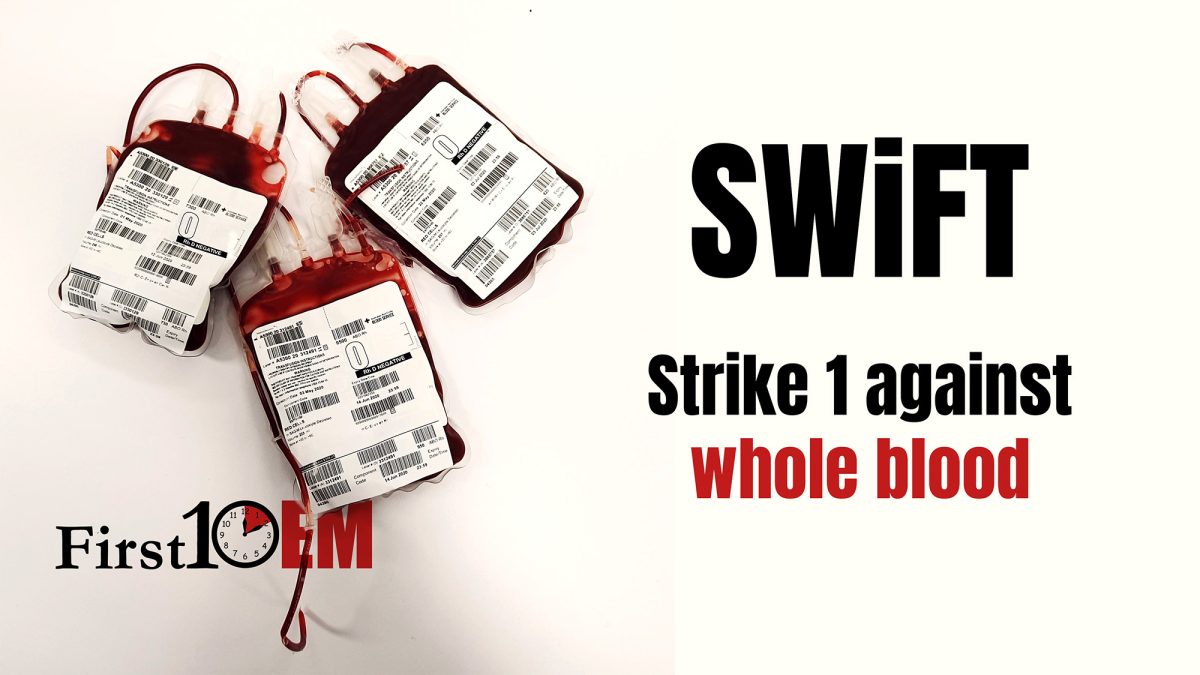
Morgenstern, J. No benefit from whole blood – the SWiFT trial, First10EM, March 30, 2026. Available at:
https://doi.org/10.51684/FIRS.145315
At this point, most people in the emergency medicine and critical care worlds just assume that balanced (ie, 1:1:1) transfusion is a proven intervention, and the focus has mostly moved on the the potential of whole blood. I am in an almost nonexistent minority when I argue that balanced transfusion is certainly not proven, and may even turn out to be harmful, but that is what the data seems to say. With that perspective, I also remain very skeptical of the value of whole blood. We now have the results of the first of many large RCTs assessing the role of whole blood in trauma – the SWiFT trial.
The question
Does prehospital whole blood improve death or massive transfusion requirements when compared to standard blood component therapy in patients with life-threatening traumatic hemorrhage?
The paper
The SWiFT trial: Smith JE, Cardigan R, Sanderson E, Silsby L, Rourke C, Barnard EBG, Basham P, Antonacci G, Charlewood R, Dallas N, Davies J, Goodwin E, Hawton A, Hudson C, Lucas J, Keen K, Lyon RM, Nolan B, Perkins GD, Rundell V, Smith L, Stanworth SJ, Weaver A, Woolley T, Green L; SWiFT Trial Group. Prehospital Whole Blood in Traumatic Hemorrhage – a Randomized Controlled Trial. N Engl J Med. 2026 Mar 17. doi: 10.1056/NEJMoa2516043. Epub ahead of print. PMID: 41841706
The methods
The SWiFT trial was a pragmatic, phase 3, multicenter, unblinded, randomized, controlled trial from 10 air ambulance services in the United Kingdom.
Patients
Patients of any age with a traumatic injury requiring prehospital transfusion (at the discretion of the testing team).
Exclusions: IV or IO access could not be established, known objection to blood products, received blood products before air ambulance arrival, in cardiac arrest.
Intervention
Whole blood: up to 2 units of whole blood.
Comparison
Standard component therapy: up to 2 units of red cells and 2 units of plasma.
Outcome
The primary outcome was a composite of death from any cause or massive transfusion (defined as ≥10 units of any blood components in adults, and ≥40 ml per kilogram of body weight in pediatric participants) within 24 hours of randomization.
The results
They enrolled a total of 942 patients, of whom 641 are included in the intention to treat analysis. As expected with trauma studies, most patients (76%) were male, and that majority (71%) was blunt trauma. The median injury severity score was 33. To my eye, the groups look pretty similar at baseline.
There was no difference in the primary outcome: 48.7% of the whole blood group and 47.7% of the standard care group died or required massive transfusion within 24 hours (adjusted relative risk, 1.02; 95% CI 0.80 to 1.31; P = 0.84).
Mortality was the same in both groups.
Blood products used in the first 24 hours in hospital were the same in both groups.
The whole blood group had a higher percentage of patients with abnormal prothombin time (41% vs 31%).


My thoughts
This is the first large RCT of whole blood in trauma, and it is clearly negative. In that context, it is clearly an important trial.
I love seeing high quality prehospital research, but given the significant logistical problems with prehospital transfusion, it seems strange to me to see prehospital research published before RCTs taking place in trauma centers. Unfortunately, I think that results in the biggest weakness of this trial. This trial only looks at 2 units of blood. In the context of sick trauma patients receiving massive transfusion, that is a drop in the bucket. Any difference between the two approaches would be quickly washed out by the large volume of identical products they received after arriving in the hospital. No matter what your feelings on whole blood or component therapy, I think we can all agree that the differences are not going to be seen with just 2 units.
So, as much as I believe the results of this trial, and predict that whole blood trials will be negative, I don’t think this trial actually shifts the needle on the debate. We still need to see the trials where large volumes of blood are being given in trauma centers.
Additionally, although 942 participants sounds big, and they actually increased the trial size after a preplanned interim analysis, the trial is almost certainly underpowered. They assumed they would see a 12% absolute benefit in their power calculation, which seems incredibly optimistic for just 2 units of blood. Trials that are too small are more likely to end up with false negative results.
There is a big difference between the number of patients enrolled and the number included in the final analysis. Although that can be a problem, there is a very good reason in this trial. The only blood being carried by the helicopters was the study blood. Therefore, every patient who needed blood needed the study blood, even if they didn’t fit the criteria (were in traumatic cardiac arrest or had non-traumatic hemorrhage). I normally worry that such retrospective exclusions increase bias, especially in unblinded trials, because they allow clinicians to exclude cases selectively. However, I don’t think that is a big concern in this trial, and there is really no other way it could be designed.
One aspect of the trial I cannot understand: there were 7% protocol violations in both groups. Given that the randomization occurred in the transfusion lab, and the helicopters were only carrying one box of blood products – the box they were randomized to – I don’t understand how there could have been a protocol violation. They shouldn’t have had the opposing blood product to give. Can anyone explain this to me? (EDIT: Perhaps solved? Patients were excluded if they received blood products prior to air ambulance arrival. I originally read that as meaning that patients were excluded if referring hospitals gave any blood products, but you could easily imagine a scenario where there helicopter arrives and the referring hospital decides to give their own blood products.)
There is observational data that is thought to support whole blood over component therapy. I think that data suffers from the same sorts of biases that fundamentally flaw the observational data ‘supporting’ balanced transfusion. When it comes to balanced transfusion, we only have 2 RCTs: one was negative and the other actually showed increased mortality from the balanced approach. The theory that whole blood will be beneficial rests heavily on the assumption that balanced transfusion is a good idea, and I think that theory is a very long way from being proven (and has a reasonable chance of being completely wrong). I go into more details on those thoughts, and the underlying evidence, in my deep dive into massive hemorrhage.
I look forward to seeing more RCTs on whole blood, but at this point it is pretty clear that this is an experimental therapy, not one that should be used routinely.
Bottom line
This first RCT of whole blood in trauma showed no benefit over component therapy. We definitely need, and will see, many more trials of whole blood in the future.


Other FOAMed
Massive hemorrhage: The clinical approach
Massive hemorrhage: a very deep dive
Evidence based medicine is easy