


I covered heparin for ACS in one of my earliest blog posts. In light of the study reviewed in the last post, I thought it was time for an update. What follows is a review of the evidence looking at heparin in the management of acute coronary syndromes. Despite its widespread use, I think you will find that the evidence does not strongly support the use of heparin, or actually suggests that heparin is harmful (which is my conclusion).
The RCTS
There are 8 RCTS looking at heparin in acute coronary syndrome. If you are going to change your practice and stop using heparin, like I have, it is worth reading these 8 papers yourself. Here is a very brief summary of the key points of each paper:
Note: This discussion does not include or apply to STEMI patients.
1) Théroux P, Ouimet H, McCans J, et al. Aspirin, heparin, or both to treat acute unstable angina. N Engl J Med. 1988;319:(17)1105-11. PMID: 3050522
- A prospective RCT looking at 479 patients diagnosed with unstable angina and admitted to the CCU. The diagnosis of unstable angina was different in 1988 than it is today. These are all high risk patients. All patients had ECG changes.
- This was a 4 arm trial: ASA+placebo, ASA+heparin, heparin+placebo, placebo+placebo.
- All 3 active treatment groups were clearly better than placebo. There were no statistical differences between the active treatment groups. (In other words, heparin was better than placebo, but did not appear to add any benefit in patients who were given ASA.) However, the raw numbers hint at a possible benefit.
- Heparin doubled serious bleeding compared to ASA, or placebo (8% vs 3%).
| Placebo | ASA | Heparin | ASA + Heparin | |
| Death | 1.7% | 0% | 0% | 0% |
| MI | 11.9% | 3.3% | o.8% | 1.6% |
| Refractory Angina | 22.9% | 16.5% | 8.5% | 10.7% |
- The combo of ASA plus heparin actually looks worse than heparin alone. This is probable simple statistical chance. However, if you believe the numbers here, you have to consider that ASA has since been proven to have a mortality benefit, so we would never give heparin alone.
Bottom line: In patients treated with ASA, heparin showed no benefit, but increased bleeding
2) The RISC trial: Risk of myocardial infarction and death during treatment with low dose aspirin and intravenous heparin in men with unstable coronary artery disease. The RISC Group. Lancet. 1990;336:(8719)827-30. PMID: 1976875
- A prospective, multi-center RCT of 796 men with unstable angina or non-Q-wave MI. Again, all patients with unstable angina had ECG changes, either at rest or on an exercise ECG.
- There were 4 arms: ASA+placebo, ASA+heparin, heparin+placebo, placebo+placebo.
- ASA was given as 75mg daily for a year. Heparin was given as a set IV dose (5000 unit q6h) for 5 days.
- ASA was better than placebo at all time points.
- At 90 days there was no difference in death or MI with heparin. When looking at secondary outcomes, they noted a decrease in MIs while on heparin at day 5, but there was a rebound effect where the numbers equalized as soon as the heparin was stopped.
| Placebo | Heparin | ASA | ASA + Heparin | |
| 90 death or MI | 18% | 17% | 7% | 6% |
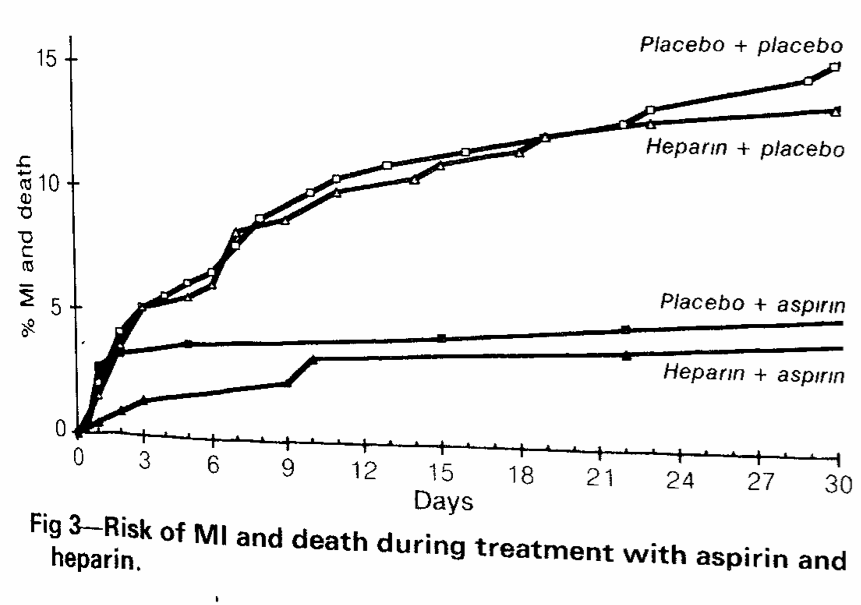
Bottom line: There was no benefit from heparin in this trial, whether it was given alone or with ASA.
3) Cohen M, Adams PC, Hawkins L, Bach M, Fuster V. Usefulness of antithrombotic therapy in resting angina pectoris or non-Q-wave myocardial infarction in preventing death and myocardial infarction (a pilot study from the Antithrombotic Therapy in Acute Coronary Syndromes Study Group). Am J Cardiol. 1990;66:(19)1287-92. PMID: 2244556
- This is a small pilot RCT of 93 patients with unstable angina (with objective evidence such as ECG changes) or non-Q-wave MIs.
- They looked at 3 groups:
- ASA alone
- Heparin followed by warfarin (alone)
- The combination of ASA and heparin/warfarin
- There were almost no objective outcomes, so it is hard to take anything from this trial. There was only 1 death in follow up (in the heparin alone group), and only 4 MIs (3 in the heparin group and 1 in the ASA group).
- Recurrent ischemia occured in 22% on the ASA group, 25% of the heparin group, and 45% of the combination group.
- Clearly this trial is underpowered, but also doesn’t hint at any benefit to adding heparin to ASA.
Bottom line: No benefit of the combination of heparin and warfarin in this trial.
4) Holdright D, Patel D, Cunningham D, et al. Comparison of the effect of heparin and aspirin versus aspirin alone on transient myocardial ischemia and in-hospital prognosis in patients with unstable angina. J Am Coll Cardiol. 1994;24:(1)39-45. PMID: 8006281 [free full text]
- A prospective RCT of 285 patients with clinically diagnosed unstable angina (but using a stricter definition that I see thrown around today).
- Patients were randomized to get ASA+placebo or ASA+heparin.
- Heparin was given as a 5000 unit bolus followed by an infusion to target aPTT of 1.5-2.5x normal.
- They had patients on continuous monitoring for ST segment changes, and there was no difference between the groups in terms of total duration of ischemia.
- There was also no difference in death or MI at 30 days.

Bottom line: Noticing a trend? There was no benefit of adding heparin to ASA in this trial.
5) Cohen M, Adams PC, Parry G, et al. Combination antithrombotic therapy in unstable rest angina and non-Q-wave infarction in nonprior aspirin users. Primary end points analysis from the ATACS trial. Antithrombotic Therapy in Acute Coronary Syndromes Research Group. Circulation. 1994;89:(1)81-8. PMID: 8281698 [free full text]
- An open-label RCT of 214 patients with unstable angina (with objective evidence like ECG changes) or non-Q-wave MIs.
- They compared ASA alone vs ASA plus heparin followed by 3 months of warfarin (presumably, looking to counter the rebound effect seen in the RISC trial).
- Heparin dosed to target aPTT 2x normal.
- INR target 2-3.
- There was no statistical difference in the primary outcome of recurrent angina/MI/death at 3 months (19% vs 28%, p=0.09).
| ASA | ASA + Anticoagulation | |
| Death | 2% | 2% |
| MI | 8% | 6% |
- They did a post hoc analysis looking only at the outcomes after 14 days, and found a difference in the composite outcome (10.5% versus 27%, p=0.004). Not only was this an unplanned secondary analysis, but it is pretty meaningless, considering they demonstrated no benefit at 30 days (the primary outcome). Despite the fact their trial was negative, they use this post hoc secondary outcome to conclude “combination antithrombotic therapy with aspirin plus anticoagulation significantly reduces recurrent ischemic events in the early phase of unstable angina”. They also combine their data with prior trials, but use this number instead of their primary outcome. This is some very poor peer review and journal editing.
- Unfortunately, they did not follow these patients after the warfarin was stopped to see if the rebound occurred later.
- Major bleeding was significantly increased with anticoagulation (0 vs 3%).
Bottom line: This is a negative trial. There was no benefit from adding anticoagulation to ASA. I would not trust the biased conclusions made based on a post-hoc analysis, but more importantly, short term outcomes don’t matter much if all the benefit has evaporated by 1 month.
6) Gurfinkel EP, Manos EJ, Mejaíl RI, et al. Low molecular weight heparin versus regular heparin or aspirin in the treatment of unstable angina and silent ischemia. J Am Coll Cardiol. 1995;26:(2)313-8. PMID: 7608429 [free full text]
- A single blind RCT of 211 patients (out of 666 screened) with unstable angina (with objective evidence).
- 3 groups:
- ASA alone
- ASA + heparin
- ASA + LMWH
- Unfortunately, unlike prior trials that looked at 30 or 90 day outcomes, they only followed these patients while they were inpatients up to a maximum of 7 days. (This is a big problem when you consider the small early benefit seen in RISC, which quickly rebounded to demonstrate no benefit at 30 or 90 days).
- There was no difference between ASA + heparin versus ASA alone except increased bleeding. LMWH did have a decrease in MI/recurrent ischemia over the short term (but with no long term follow up).
| ASA alone | ASA + Heparin | ASA + LMWH | |
| MI | 9.5% | 6% | 0% |
| MI + recurrent ischemia | 59% | 63% | 22% |
| Major bleeding | 0% | 3% | 0% |
Bottom line: Unfortunately, there was no long term follow up in this trial. In the first week the LMWH, but not heparin, led to a decrease in both MI and recurrent ischemia. The big question is: if they had followed their patients beyond one week, would they have seen the same rebound effect as in every other study?
7) The FRISC trial: Low-molecular-weight heparin during instability in coronary artery disease, Fragmin during Instability in Coronary Artery Disease (FRISC) study group. Lancet (London, England). 1996; 347(9001):561-8. PMID: 8596317
- A multi-centre, double-blind, placebo controlled RCT of 1506 patients with unstable angina or non-Q-wave MI. (They had to have ST depression or T wave inversion. Unstable angina was a different entity back in the day.) There is a high chance of selection bias, as only 30% of eligible patients were enrolled.
- They compared dalteparin to placebo in a group of patients where everyone gets ASA.
- The dalteparin dose was 120 units/kg BID for the first 6 days, then 7500 units daily for another 45 days.
- The results of this trial depend a lot on what time point you decide to focus on. Despite following patients for 150 days (and having a 98% follow-up rate), this industry funded study decided to set the primary outcome as the much less patient oriented 6 day rate of death and MI.
- There was a statistically significant decrease in the combination of death and MI at 6 days (4.8% vs 1.8%, p=0.001). Mortality wasn’t actually decreased, just MI.
- By 40 days, the rate of death and MI was no longer statistically significant (10.7% vs 8.0%, p=0.07).
- At 150 days, there were no differences between the groups.
| Dalteparin | Placebo | P value | |
| 6 day death | 0.9% | 1.1% | 0.8 |
| 6 day MI | 1.4% | 4.4% | 0.001 |
| 150 day death | 5.4% | 5.5% | not reported |
| 150 day MI | 11.7% | 13.4% | 0.3 |
- So if your patient cares only about what happens to them at 6 days and not at a month or longer, dalteparin may be a good choice.
Bottom line: There were no difference at 150 day follow up between the groups, but the primary outcome at 6 days showed a decrease in MIs.
8) The FAMI trial: Kakkar VV, Iyengar SS, De Lorenzo F, Hargreaves JR, Kadziola ZA, . Low molecular weight heparin for treatment of acute myocardial infarction (FAMI): Fragmin (dalteparin sodium) in acute myocardial infarction. Indian heart journal. ; 52(5):533-9. PMID: 11256775
- I don’t have access to this paper, so can’t do a full appraisal.
- It is a multicentre, double-blind, placebo-controlled comparing dalteparin to placebo in 1128 patients with MI who didn’t receive thrombolytics.
- There was no difference in the primary composite outcome of death, reinfarction, recurrence of angina and emergency revascularisation (6.7% vs 7.0%, RR 0.97; 95% CI 0.62-1.52; p=0.90)
Other heparin trials
Chen JY, He PC, Liu YH, et al. Association of Parenteral Anticoagulation Therapy With Outcomes in Chinese Patients Undergoing Percutaneous Coronary Intervention for Non-ST-Segment Elevation Acute Coronary Syndrome. JAMA internal medicine. 2018; PMID: 30592483
This is the trial the prompted me to update this post. It is a retrospective review, looking at 6800 non-ST elevation ACS patients who everwent PCI. Patients who received heparin had the same rate of MI and death as those who did not receive heparin. The only difference between the groups was that heparin was associated with an increased rate of major bleeding.
You can read the full write up here.
Systematic Review
Andrade-Castellanos CA, Colunga-Lozano LE, Delgado-Figueroa N, Magee K. Heparin versus placebo for non-ST elevation acute coronary syndromes. Cochrane Database Syst Rev. 2014;6:CD003462. PMID: 24972265
For reference, this is the Cochrane review on the topic. They cover 7 of the 8 RCTs above, plus another paper that was done in patients after angiography, and also demonstrated no benefit from heparin. (Doucet 2000) They conclude that heparin does not decrease mortality. That is a consistent finding in these trials, so we can be certain that we are not saving lives by giving heparin. The review does conclude that there is a decrease in MI (RR=0.40 95% CI 0.25-0.63), however the decrease is almost entirely driven by the largest study (FRISC), and they used the 6 day outcome of that trial, rather than the 40 or 150 day outcomes that we know were negative.
Summary
We have an unfortunate habit in medicine of ignoring negative trials, but rapidly embracing anything that even hints at being positive. This is the opposite of rational behavior. Simple math tells us that negative trials are likely to be correct, while positive trials have a high probability of being wrong. Currently, research tends to stop after we have seen a positive trial. The more appropriate response is actually to increase research in that area, aiming to either falsify the incorrect claim before patients are harmed, or confirm the finding through repetition.
The one certainty from this data seems to be that heparin does not save lives.
Taken as a whole, this literature seems to illustrate that heparin has a physiologic effect that can be demonstrated early after an MI. In the first few days of therapy, the number of non-fatal MIs is decreased. The importance of a non-fatal MI (aka an increased lab test) is a good question, but it turns out to be irrelevant here, because as soon as the heparin stops, there is a rebound effect and all benefit is lost. In terms of patient oriented outcomes, there is clearly no benefit at one month from giving heparin.
The major caveat is that all of these studies were done in a pre-catheterization era. One could theorize that a stent might prevent the rebound we are seeing when heparin is stopped. Maybe this is a good bridge to intervention.
However, we have to recognize that this is just a theory. There is no science to back up this claim, and it isn’t even clear that routine stenting benefits this group of ACS patients. (Fanning 2016)
Even if the short term benefit was carried forward by stents, it is important to closely examine the outcomes. There is no change in mortality. We might decrease non-fatal MIs by about 3%. However, that benefit is balanced by the approximately 3-4% increase in major bleeding. So even in this theoretical world, heparin is not clearly beneficial.
My most important take home point: Heparin is often started on patients without any informed choice or shared decision making process. It is started because “this is an MI, and we need to treat it.” However, heparin is not a life saving medication, and there is nothing here that warrants giving it without consent.
I don’t prescribe heparin in NSTEMI or unstable angina patients. However, if I for some reason felt compelled to, I would tell my patient: “We have this medicine, called heparin, that has traditionally been given to all patients with a heart attack. It will not change whether you live or die. It decreases heart attacks in the first week, but by one month there is no benefit to this medicine. The major side effect of this medicine is that about 1 in 33 people will have a problem with major bleeding, such as vomiting blood, bleeding in the brain, or requiring blood transfusions.”
And assuming my doctor gave me the choice, I absolutely would not want to be given heparin if I happened to be having an NSTEMI.
Other FOAMed
PulmCrit: Mythbusting: Heparin isn’t beneficial for noninvasive management of NSTEMI
Other References
Doucet S, Malekianpour M, Théroux P, et al. Randomized trial comparing intravenous nitroglycerin and heparin for treatment of unstable angina secondary to restenosis after coronary artery angioplasty. Circulation. 2000; 101(9):955-61. [pubmed]
Fanning JP, Nyong J, Scott IA, Aroney CN, Walters DL. Routine invasive strategies versus selective invasive strategies for unstable angina and non-ST elevation myocardial infarction in the stent era. The Cochrane database of systematic reviews. 2016.
Morgenstern, J. Heparin for Acute Coronary Syndrome: an evidence review, First10EM, January 7, 2019. Available at:
https://doi.org/10.51684/FIRS.7161
Some other trials
OASIS-5: Yusuf S, Mehta SR, et al. Comparison of fondaparinux and enoxaparin in acute coronary syndromes. The New England journal of medicine. 2006; 354(14):1464-76. [pubmed] [free full text]
- This is a randomized, double-blind trial comparing fondaparinux and enoxparin in 20,078 patients with NSTEMI and unstable angina.
- For the primary outcome, a composite of death, MI, and refractory ischemia, fondaparinux was non-inferior to enoxaparin (5.8% vs 5.7%; p=0.007). For the primary safety outcome, there was less major bleeding with fondaparinux (4.1% vs 2.2%, p<0.001).
- However, seeing as all the placebo controlled studies above say that enoxaparin doesn’t provide any benefit, being non-inferior isn’t helpful in any way. We don’t need to be comparing the adverse event rates, because we shouldn’t be giving either agent if there is no benefit.